Sunday, August 16, 2009

Reaction to Part 1

The Shadow of Mount Elgon

After reading the first section of Richard Preston's The Hot Zone, I was utterly astonished. I was amazed by the speed at which the Ebola virus could jump from one host to another; I was completely aware of the fact that this virus could easily wipe out the entire human race within months. I was amazed the the "most powerful beings on earth", the king of the animals, the dwellers of Wall Street, and the multi-millionaires could be obliterated by something they couldn't even see with their naked eye, a sort of sick irony. Yet, even with all this knowledge, I was not quite frightened. Terror was not, in fact, pounding through my veins; my honest first thought was, "Wow, that's what I want to do with my life." It seems masochistic to want to hop into a space suit, blue gloves tapped to my medical scrubs underneath, enter a Level 4 hot zone, and play around with something more lethal that rattlesnake venom, stronger than a sharks bite, and more terrifying than an AK-47 pointed at your chest; but it's exhilarating, and that's what I live for.

Lauren's Hot Zone Reaction - Part 4

Reading the final part of The Hot Zone was captivating how it ended where it all started. The way the author Preston describes the beautiful scenery as if untouched sounded so moving and simply beautiful. Anyone who would ever come across these lands wouldn't even consider the possible danger of a deadly virus waiting for it's next host. As intriguing as reading about Preston's experiment as to see how this virus generates, it was somewhat a disappointment that there's not more to tell about this virus. I was somewhat hoping that if not a cure was found, someone would eventually see how it can cause so much damage to human, monkeys, and guinea pigs, but not to other animals like possibly bats or a specific kind of insect. I learned so much from this book, but it leaves me asking for more answers. I can see now why some people the Jaax couple and Gene Johnson to name a few can put themselves inches from death. Because as horrible as it sounds, there is a point that sounds captivating and moving of learning more about something so strange and unknown like the Ebola.

Jada's Biology Collection. Starring My Phone


Radial Symmetry
When the petals are of the same size, shape, and are equidistant from each other, the flower has radial symmetry. As you can see, the white flower pictured has radial symmetry.
Basidiomycete

The phylum basidiomycota consists of fungi that produce spores that are formed outside a pedestal-like structure. The members of this phylum, known as basidiomycetes, include all the fungi with gills or pores, which the mushroom I have pictured is a perfect example of.


Homeostasis

When an organism is in a state of homeostasis it is able to maintain a stable, constant condition. In order to maintain her state of homeostasis, my sister takes a midday nap to rejuvenate her body. Another way to maintain our human homeostasis is consuming the right nutrients to help keep our internal structures functioning properly.


Exoskeleton

Shells are hard, largely calcareous exoskeletons of marine animals, especially mollusks. I have this shell from a Galveston beach because it fascinates me that it was once a home to a small creature.


Ethylene


Ethylene, H2C=CH2, is a plant hormone compound that has the simplest structure in its class. One practical use of ethylene is to make polyethylene, which is used to make the ever-popular shopping bag (like pictured).


Epithelial Tissue

The skin on my body (including my beautiful arm pictured) is made up of epithelial tissue. This tissue acts as an interface between my body and the rest of the world. It is made up of cells that are tightly packed together, and it helps protect me from microorganisms and injury


Endosperm

Endosperm is the tissue produced in seeds of most flowering plants around the time of fertilization. It can be a source of nutrition for humans. Wheat endosperm is ground into flour to make bread, like the bread pictured. Once cheese and ham are placed on this slide, it becomes a perfect snack, and the human can benefit from the starch, oils, and proteins from the endosperm.


Ectotherm

An ectotherm is an animal that must use external sources of heat to maintain its regular body temperature. I often find lizards crawling around the outside lights around my house and thought they would be perfect models. They crawl around to soak in the heat from the lights, for they are cold-blooded creatures.


Parasitism

A mosquito sucked blood from my foot, and I was harmed while the insect now has a full stomach. Somewhat similar to commensalism, the mosquito practiced parasitism when it sucked my blood. But not only did I not benefit from its actions, I was harmed as well.


Commensalism

This green moss has a commensal relationship with the tree because it benefits from some of the nutrients that may fall down the bark, making it ahead of the game when competing with mosses on the forest floor. The moss also has access to more sunlight that it needs, while the tree neither gains nor loses from having its new green furry friend.


Frond

A frond is a type of leaf that has many divisions in it. The palm pictured is an example of a frond leaf. Ferns and cycads also have fronds.


Bilateral Symmetry

The little butterfly I found on a decorative rock in my front yard has perfect bilateral symmetry. If one were to draw a line (like the one shown) from the tip of its antennae down through its abdomen, either side of the butterfly would be perfectly identical.
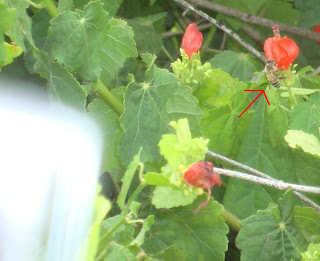


Pollinator

The bee on the right-hand side of the picture is a pollinator, because it has the ability to be a vector of pollen to another plant. Once the pollen sacs have been dropped onto another flower, the pollination begins!


Anther and Filament of a Stamen
The yellow stamens can be seen at the middle of this pretty pink flower. The anther is the yellow tip, and the filament is the long stem sort of thing that makes up most of the stamen. They surround the pistol, which is the female ovary of the flower.


Animal that has a segmented body

The very small ant in the center of the picture has a segmented body: head, thorax, and abdomen.


Genevieve's Biology Collection 2

1. Bilateral Symmetry
When an organism's plane is split into two mirrored halves. Most animals, including humans, have bilateral symmetry


2. Connective Tissue
One classification of the four types of tissue. Connective tissue plays a part in forming ligaments and tendons, like in our hands.


3. Cuticle Layer of a plant
The plant cuticle is a protective waxy layer over a plant's leaf.


4. Eubacteria
Also called just bacteria, are prokaryotic, and are responsible for many sicknesses, but also are helpful in many ways to our body, like the bacteria in yogurt.


5. Eukaryote
and organism who's cells contain complex structures enclosed by membranes. Most large organisms have eukaryotic cells, like horses.


6. Fermentation
is the process of producing energy by the oxidation of organic compounds, such as carbohydrates. One fermentation product is lactic acid, an acid that builds up in muscles when you work out.


7. Flower Ovary
female part of a plants reproductive system. The part of the flower that holds the ovules, connected to the base of the petal.


8. Genetic Variation within a population
The difference between genes in a population, providing a chance for natural selection to happen.


9. Long-day plant
plant that requires fewer than a certain number of hours of darkness in each 24-hour period to induce flowering. Lettuce is one such plant.


10. Modified Leaf of a plant
A modified leaf is a leaf that has been adapted for another purpose besides storing food and water, like a spine leaf, which is modified to protect.


11. Modified Stem of a plant
Offshoots are modified stems in plants that apply to lateral branches, often found on pineapples.


12. Pollinator
The 'agent' that moves pollen from the male anthers to the female stigma of a flower to accomplish fertilization; the most commonly known pollinator it the bee.


13. population
the collection of inter-breeding organisms of a particular species.


14. Predation
an interaction between organisms where a predator feeds on its prey...(don't worry, my dog didn't eat the bird)


15. Stigma and Style of Carpel
the stigma must distinguish between the right kinds of pollen, specie-wise, and the style provides support for pollen tubes, so that the pollen may be transported correctly.

Lauren's Hot Zone Reaction - Part 3

After reading about the whole process of studying, terminating the monkeys, and decontaminating the place, I feel like I had been standing there during every step and procedure taken. To be in these officer's shoes sounds exhausting and frightening. It was shocking to hear that one girl working on the case looked as young as 18 years old (318). To think that if someone begins to feel just ever so slightly tired, that it can ruin everything and cause so much damage. Also, I was very intrigued as to know that there are two different strands of Ebola, one causing very little harm, and the other being disastrous. The chilling thing to see on page 368, was that there was no difference whatsoever and could easily be mistaken, but could either be not to worry or cause a frenzy. This book was so captivating, I was so glad to read that it did become under controlled and that the town of Reston could go another day.

Lauren's Hot Zone Reaction - Part 2

A car accident can happen in a matter of seconds. One second you can be driving down the road, then next look down for a millisecond to turn down the AC and BAM. You hit the car in front causing you to be late to an event and pray that your car isn't totaled. Ebola virus is similar in the way that it can happen any time, anywhere causing chaos and affecting everyone around you. With a car accident, evidently there will be some slight to major traffic, causing not only yourself, but everyone else to be late to work or wherever they're suppose to be. So when reading about the Ebola virus had surfaced in a monkey house in Reston, VA run by Dan Dalgard, it was terrifying to read how Ebola was so close to coming out into the open in the United States and causing epidemic. Having something like this hit so close to home really puts things in perspective as to what could have happened if Dalgard wasn't serious about his position and didn't put too much thought as to how the monkeys were dying and what was causing it to spread into the other monkeys, in some cases ones that weren't even held in the same area.
As I read on, I'm glad to see characters in the book who already have experienced handling the situation seriously and carefully as well as keeping it away from the media in order to not start a panic. It's so interesting to read about the steps taken in order to control this virus and keep it from spreading around into the outside world. Personally, when it mentioned the children outside playing nearby, it really just showed how close the Ebola was to causing a crisis that could have almost completely wiped out the area. With the continuation of reading, I'm interested as to read how the Jaaxes among the Army find a way to control the situation and decontaminate the area. But it also crosses my mind that hopefully no one working on the project will fall ill causing it to spread like wildfire. With that, I look forward to reading about the precautions and hearing witnesses story as to being so close to touching death.

Christina's Hot Zone Reaction: Part 4

Part Four

Kitum Cave

This part had a lot of interesting facts about Africa and AIDS. I had never heard of this “AIDS highway” and the percentages that he gives in this part are unbelievable. “Local doctors say think that as many as 30 percent of all men and women of childbearing age who live in the vicinity of Mount Elgon are infected with HIV” (382). His talking about AIDS definitely brings Ebola into perspective. AIDS “has already cost at least 10 million lives” (383). AIDS has destroyed so many more lives, and Ebola could do the same, it would just be much faster.

His descriptions of the African rainforest are so beautiful. It seems weird and out-of-place that a deadly virus would live there. After many sentences of the rainforest getting back at the human race. He gives the readers a terrifying statement/prediction as the last sentence of his novel, “It will be back” (411).